
Schools and children in Berlin
Children and schools in Berlin: what options are available to Russian-speaking families, how much it costs and how to apply.
Children’s education in Berlin: the system, neighbourhoods, and real options
Relocating to Berlin with school-age children requires decisions before you even have the keys to your apartment. Germany’s education system works differently from most post-Soviet countries: there is no single ’secondary school’ — instead there are several types with different trajectories, and ending up in the wrong one at age 10 can close the path to university. For Russian-speaking families, there is the additional question of language, cultural identity, and the choice between the state and private systems.
Berlin public schools: how the system works
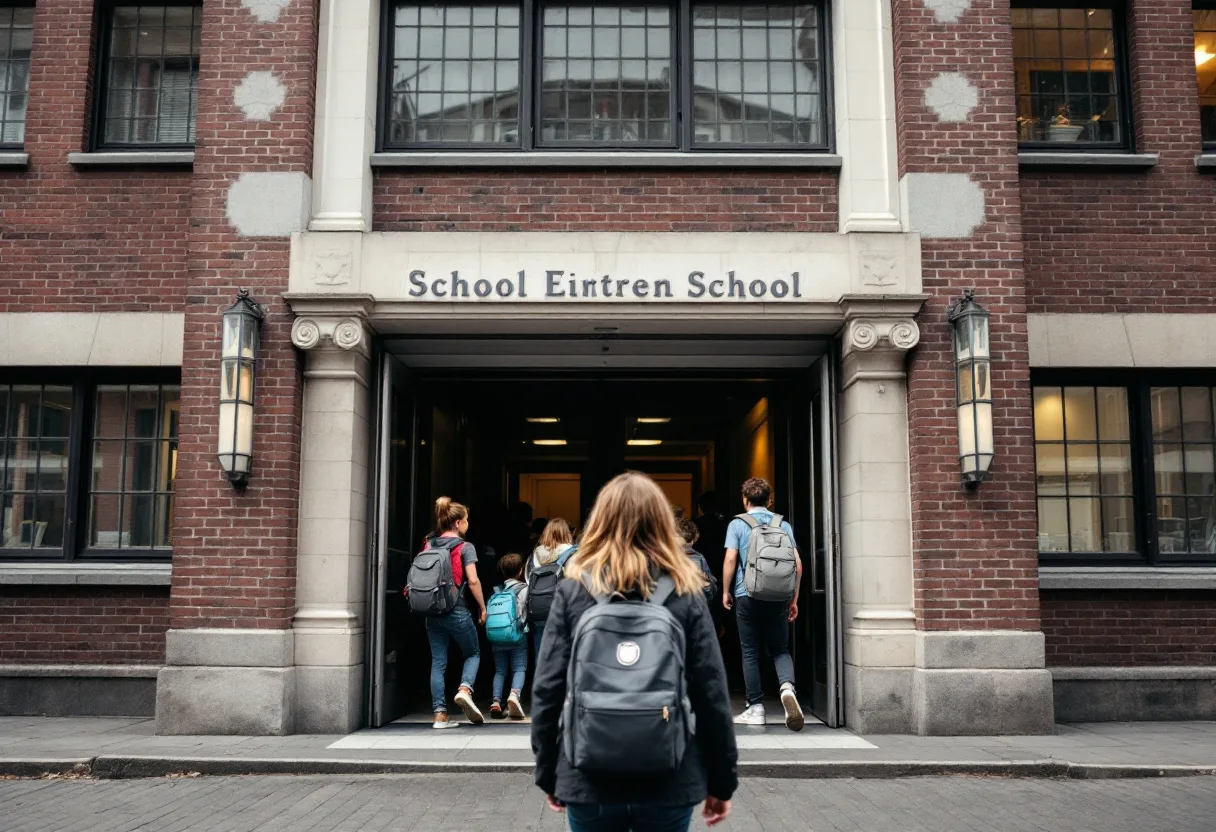
Instruction is in German and is compulsory and free. A child must be enrolled in school within 6 weeks of registering at an address (Anmeldung). Enrollment is handled through the district Schulamt, which is tied to a specific Bezirk.
The system is divided into several levels:
- Grundschule — primary school, grades 1–6 (in Berlin, unlike other federal states, it runs for 6 years rather than 4).
- Integrierte Sekundarschule (ISS) — an integrated school through grade 10, with the option of Abitur at grades 12–13.
- Gymnasium — the academic track leading to the Abitur, entry after grade 6 based on a teacher’s recommendation.
- Gesamtschule — a mixed-format school that keeps the option of switching tracks open.
Schools are required to offer children without German a place in a Willkommensklasse — a welcome class for language immersion. This typically runs for 1–2 years alongside regular lessons. The realistic timeline for a child to reach comfortable mainstream learning is 12 to 24 months, depending on age and the intensity of outside-school study.
Insider moment: the quality of state schools in Berlin varies significantly by neighbourhood. Schools in Pankow, Zehlendorf, and Steglitz are traditionally stronger academically than those in Neukölln or Mitte, where high proportions of migrant children and a chronic shortage of teachers are common. Expat families know this — and when choosing an apartment, they often look specifically at the area’s school ratings.
Private and international schools in Berlin
For families for whom programme continuity or English-language instruction matters, there are several reliable options.
| Option | Best for | Cost (per month) | Key note |
|---|---|---|---|
| Berlin Brandenburg International School (BBIS) | Families with IB program, corporate relocation | 1,800–2,400 € | Outside the city, transportation required |
| Berlin Cosmopolitan School | IT families, mixed English-German | 900–1,400 € | Long waiting list |
| Phorms Berlin | Bilingual (DE/EN), multiple campuses | 800–1,300 € | Kindergarten and school under one roof |
| Staatliche Schule (Pankow/Steglitz district) | Long-term residents, integration-focused | 0 € | German language required over time |
| Russian weekend school | Parallel language preservation | 80–150 € | Not a replacement for mainstream school |
Phorms is one of the most popular choices among Russian-speaking families: it offers Kita (nursery) from age 3 through to Year 13 under one roof, and its bilingual programme eases the language transition during relocation.
Kindergartens in Berlin: Kita and waiting lists
Kindergartens in Berlin are officially called Kita (Kindertagesstätte). By law, every child is entitled to a place from age 1, but in practice the waiting list for a state Kita is 6 to 18 months. You should register as soon as your move is confirmed — via the KitaNavigator Berlin portal or directly with individual facilities.
The state Kita for children aged 1 to 3 costs from 23 to 270 € per month, depending on family income (Elternbeitrag). From age 3 until school age — free for families below a certain income threshold, or a minimal contribution applies.
Private Kita and Krippe (nurseries) charge €400–900 per month regardless of income, but you can usually get a spot within 2–4 weeks.
Insider moment: many Kitas in Berlin operate only until 16:00–17:00, which creates a real problem for two working parents. Before choosing, check the Öffnungszeiten (opening hours) and whether a Hort — an after-school programme — is available.
Russian school in Berlin: what it is and how it works
A Russian school in Berlin is not an alternative to the German system — it is a supplement. Most Russian-speaking families enrol their children in Saturday or Sunday schools to maintain literacy in Russian, a solid maths foundation following the Russian curriculum, and a connection to Russian culture.
The main formats:
- The embassy Russian school — an academic programme close to the Russian curriculum, but with limited places and priority given to diplomatic families.
- Independent Russian-language schools (for example, in Pankow and Charlottenburg) — run by émigré teachers, with a focus on literature, mathematics, and history. Fees: €80–150 per month.
- Online formats with Russian and Belarusian teachers — convenient as a supplement, but no substitute for a live environment.
For children who arrived at age 10–12, attending a Russian school in parallel significantly reduces academic lag in exact sciences while language adaptation to the German system is still underway.
Common mistakes
-
Enrolling your child in school after the move rather than before. Places at good Grundschulen are tied to your address — in high-demand neighbourhoods, a child may not get into the school you want. Some families deliberately register at the address of a relative or acquaintance in the right Bezirk.
-
Assuming the child will ’just pick up the language at school.’ Without additional German lessons — a minimum of 3–4 hours per week, individual or group — time in the Willkommensklasse drags on and the move to a regular class is delayed.
-
Choosing a private school without checking accreditation. Not all private schools in Berlin are state-recognized (staatlich anerkannt). A diploma from an unrecognized school does not qualify a student for admission to a German university.
-
Overlooking the Kita waiting list. Families who arrive with a young child and expect to return to work within 2–3 months often face a hard reality: a spot at a state-run Kita can take much longer to secure.
-
Confusing school types when choosing a track after 6th grade. Parents often agree to an ISS placement without realising it significantly narrows university options. The decision is made quickly — it pays to know the recommendation criteria in advance.
-
Pulling children from Russian-language school to ’speed up integration.’ Experience shows the opposite: bilingual children adapt better, and the loss of solid Russian literacy at ages 8–10 is almost irreversible.
Who should choose what
If you are relocating for the long term and have pre-school-age children — join the waitlist for a state Kita immediately and consider Phorms as a backup. For school-age children, the most resilient setup for the first 2–3 years is a state school in a strong neighbourhood plus a Russian school at weekends. An international school makes sense when the length of stay is uncertain or the family is committed to an IB programme from a previous country. The key decision is made not at the moment of the move, but at the stage of choosing a neighbourhood and registration address.
School didn’t work out in Berlin? I have a US high school diploma online
Grades 1–12 in Russian, a US diploma, study from any country. Plus the child’s documents — apostille and translation.

Local school not a fit? An American diploma — while your child studies in Russian.
Texas private school, fully online: grades 1–12, curriculum and lessons in Russian, with a High School Diploma and Official Transcript upon completion. Works from any country, compatible with local schooling. Homeschool — €700 per year, Online with daily lessons — from €3,150.
Formats, fees, and enrolmentSchool in Berlin starts with the neighbourhood
The neighbourhood where you rent will determine your school: in some areas a place at a state school is assigned directly tied to the registered address; in some cases it all comes down to the morning commute. We’ll find housing with an eye on to the school and will prepare your child’s documents from Russia, Belarus, or Ukraine — with apostille and sworn translation. Both take weeks, and application windows are short.
Submit a requestFind you a home near a school
Your neighborhood determines which school will accept you
Preparing school documents
Diploma, transcripts, apostille, and translation
Not a fan of bots — write to a person
The SVOY app — a marketplace for fellow expats
Services, goods, housing, and jobs worldwide. Post your own listing for free.
SVOY SERVICES
We’ll help with that in Berlin
These tasks are handled by services within the SVOY ecosystem.
American online school
A US high school diploma — and the child studies in Russian: grades 1–12, fully online from any country. Homeschool — €700 per year; Online with daily lessons — from €3,150.
Documents and certificates
Criminal record checks, civil registry documents, school and university certificates from Russia, Belarus, and Ukraine — with apostille and certified translation, remotely. Required for schools, universities, residence permits, and employment.
Real estate
Property rental and purchase worldwide. Free property search and transaction support.
SVOY ECOSYSTEM
What else you may need
Tasks that most often come next. Each is handled by a dedicated SVOY service.
Rent or buy housing
Rental and purchase Berlin: prices by neighbourhood, property due diligence, and end-to-end transaction support — SVOY HOME.
Go to websiteRegularize your status
Residence permits, visas and status renewals in Berlin, certificates and apostille — SVOY Legal.
Go to websiteChildbirth and citizenship for the child
Childbirth in Berlin: clinics, newborn documentation and citizenship — SVOY Baby.
Go to websiteHalal community
Nikah, halal services, and the Muslim community in Berlin — SVOY Halal.
Go to websiteA U.S. diploma from home: online school in Russian, grades 1–12
Leave your contact — that’s all we need; we’ll ask the rest ourselves. If you’d like, so we can prepare for the conversation in advance, please specify your request below.
Need help relocating to Berlin?
In the international SVOY community you will find:
- Russian-language chat Berlin
- Housing and neighbourhoods
- Schools and kindergartens
- Doctors and clinics
- Lawyers and help with paperwork
- Verified contacts and recommendations
If you come with good intentions — you’re one of us.
Join the chat Berlin